


Is Your Ecommerce Store Ready for AI Shopping? (2026 UK Guide)
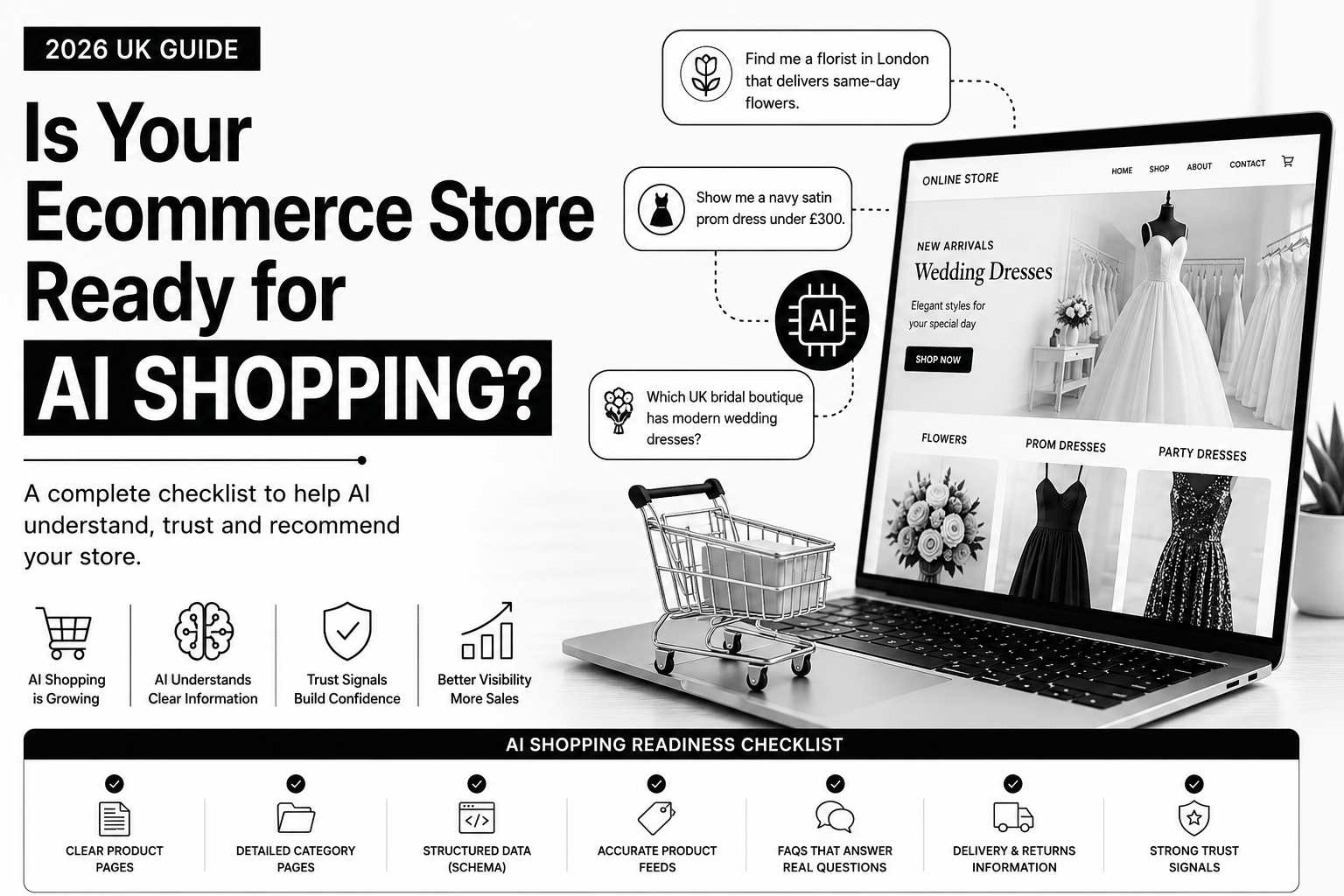
An ecommerce store is AI shopping-ready when AI platforms such as ChatGPT, Google Gemini, Perplexity and Microsoft Copilot can easily understand its products, trust its information and confidently recommend it to shoppers.
To achieve this, your store needs:
- Clear product pages
- Detailed category pages
- Structured data (Schema)
- Accurate product feeds
- FAQs
- Delivery & returns information
- Strong trust signals
Shoppers are no longer starting their journey on Google alone. A growing number are opening ChatGPT, Gemini, Perplexity or Copilot and simply asking for what they want – “Find me a florist in London that delivers same-day flowers. “or “Which UK bridal boutique has modern wedding dresses?” The AI does the searching, the comparing and, increasingly, the recommending.
This is agentic commerce, and it’s no longer a future trend. It’s live, it’s growing fast, and it changes the rules for every UK ecommerce store.
The question this guide answers is simple: is your store built in a way that AI can understand, trust and recommend? If the answer is unclear, this is your starting point.
Why AI Shopping Matters for UK Ecommerce Right Now?
AI-referred traffic to retail sites isn’t a rounding error anymore. Adobe Analytics tracked triple-digit year-on-year growth in AI-driven retail traffic through late 2025 and into 2026, and multiple industry trackers now report that shoppers who arrive via AI convert at noticeably higher rates than those from paid search or social ads largely because the AI has already matched them to a relevant product before they ever land on a site.
Google, OpenAI and Microsoft have all moved from experimentation to infrastructure. Google’s AI Overviews already appear on a meaningful share of shopping-related searches. ChatGPT has rolled out shopping and checkout features to hundreds of millions of weekly users. Perplexity and Copilot have launched their own product discovery and purchase experiences. Analysts including McKinsey and Morgan Stanley expect AI agents to influence a substantial share of UK and global retail spend before the end of the decade.
The practical takeaway for a UK ecommerce brand: if your product pages, category pages and policies aren’t structured clearly enough for an AI system to read and trust, you are being quietly filtered out of recommendations even if your website looks great and ranks reasonably on Google today.
AI Cannot Recommend What It Cannot Understand
This is the core idea, and it’s worth repeating because it changes how ecommerce sites should be built.
An AI system deciding whether to recommend your product isn’t looking at your homepage banner or your brand colours. It’s trying to answer a small number of very direct questions:
- What exactly does this product do?
- Who is it for?
- How is it different from the alternative down the road?
- What does delivery actually involve?
- What happens if the customer needs to return it?
- Can this business be trusted?
If your product pages are vague, your category pages are thin, your FAQs are missing, or your delivery and returns information is buried in a PDF from three years ago, the AI has nothing solid to work with. It will simply recommend a competitor who answered those questions clearly.
Nice design still matters for the humans who land on your site. But clarity is what gets you recommended in the first place.
SEO, GEO and AEO: Three Different Jobs
These three disciplines now need to work together, and it helps to be clear on what each one actually does:
SEO (Search Engine Optimisation) gets your products found in traditional Google search the classic blue links, product listings and shopping tabs.
GEO (Generative Engine Optimisation) helps AI systems understand and trust your store well enough to recommend it inside a generated answer, a shopping comparison, or an AI Overview.
AEO (Answer Engine Optimisation) positions your business as the direct answer when a customer asks a question, whether that’s on Google, ChatGPT, or a voice assistant.
Most UK ecommerce stores have only ever invested in the first one. In 2026, that’s no longer enough.
The Ecommerce AI-Readiness Checklist
Here’s what to review on your own store this week. Each of these is something both customers and AI systems rely on.
- Product Pages That Actually Explain the Product
Every product page should clearly state what it is, who it’s for, its key specifications, and what problem it solves in plain, specific language. Vague marketing copy (“premium quality, built to last”) gives an AI system nothing concrete to extract. Specific detail (“waterproof to 10,000mm, machine washable, fits true to size”) gives it something to work with.
- Category Pages with Real Substance
Thin category pages that are just a grid of products with no supporting text are invisible to AI systems trying to understand what a category covers. A short, genuinely useful introduction to the category what it includes, how to choose between options helps enormously.
- Structured Data and Schema Markup
Product, Offer, Review, FAQ Page and Local Business schema aren’t optional extras anymore. AI systems and AI Overviews consistently favour pages with clean, accurate structured data because it removes the guesswork. If your product feed is incomplete or your schema is missing, you are handing your competitors an advantage for free.
- Clear Delivery and Returns Information
This should live on its own well-structured page, not buried in a footer link or a scanned PDF. State delivery timeframes, costs, and the returns window in plain terms. AI systems weigh this heavily when deciding what to recommend, because it directly affects customer trust.
- FAQs Built Around Real Customer Questions
FAQ sections targeting the actual questions customers type into Google and ask AI assistants sizing, materials, delivery, returns, compatibility are some of the most valuable content on an ecommerce site right now. They’re easy for AI systems to extract and quote from directly.
- Trust and Authority Signals
Reviews, testimonials, accreditations, secure checkout badges, and a genuine about page all feed into how much an AI system trusts your business enough to recommend it over a competitor.
- A Product Feed AI Agents Can Actually Read
For platforms like Shopify, this increasingly means keeping your product feed accurate, complete and current correct pricing, real-time stock levels, and full attribute data. Incomplete or stale feeds are a common reason stores drop out of AI-driven recommendations entirely.
What Happens if You Ignore This
Nothing dramatic happens overnight. Your site keeps running, your existing customers keep buying, and your Google rankings might not move much in the short term.
What happens instead is quieter and more costly: a growing slice of new demand the shopper who never Googles, who just asks an AI assistant instead goes to a competitor with clearer product data, better structured FAQs, and a properly documented returns policy. That gap compounds every month AI shopping adoption grows.
How Digital Web London Helps?
At Digital Web London, we review ecommerce stores the way an AI system does: what’s clear, what’s missing, and what’s quietly costing you visibility and sales.
We look at what’s working, what’s wasting budget, where customers are dropping off, and what’s stopping conversions then build a clear action plan to improve visibility, trust and sales across both traditional Google search and AI-driven shopping.
No jargon. No fluff. Just clear, prioritised actions.
Want to know if your ecommerce store is ready for AI shopping? Send us your website URL and we’ll take a look.
Frequently Asked Questions
What is AI shopping? AI shopping is when customers use tools like ChatGPT, Google Gemini, Perplexity or Copilot to research, compare and sometimes purchase products, instead of browsing a search engine or a retailer’s website directly.
What is GEO in ecommerce? GEO (Generative Engine Optimisation) is the practice of structuring your website content, product data and schema markup so that AI systems can understand your store well enough to recommend it in generated answers.
How is GEO different from SEO? SEO focuses on ranking in traditional search results. GEO focuses on being understood and recommended by AI systems, which read and weigh content differently to a traditional search engine.
Does my ecommerce store need structured data for AI shopping? Yes. Structured data such as Product, Offer, Review and FAQPage schema helps AI systems and search engines confirm exactly what you sell, at what price, and what customers think of it, which increases the likelihood of being recommended.
Can a small UK ecommerce store compete with bigger retailers in AI shopping results? Yes. AI systems reward clarity, accuracy and trust signals rather than budget or brand size. A smaller store with clear product pages, honest reviews and well-documented policies can be recommended ahead of a larger competitor with thin or vague content.
How do I check if my store is already showing up in AI shopping results? Ask ChatGPT, Gemini or Perplexity a question a real customer might ask in your product category and see whether your store is mentioned, and how it’s described. This gives you a quick, honest baseline.
Digital Web London is a full-service digital marketing agency based in London, specialising in SEO, web design and AI search optimisation for ecommerce and service businesses across the UK.
Get your free health check at digitalweblondon.com →
Or speak directly with the team: hello@digitalweblondon.com
Follow us on: Facebook, Instagram, Linkedin , Youtube